Schur-MI: Fast Mutual Information for Robotic Information Gathering

Abstract
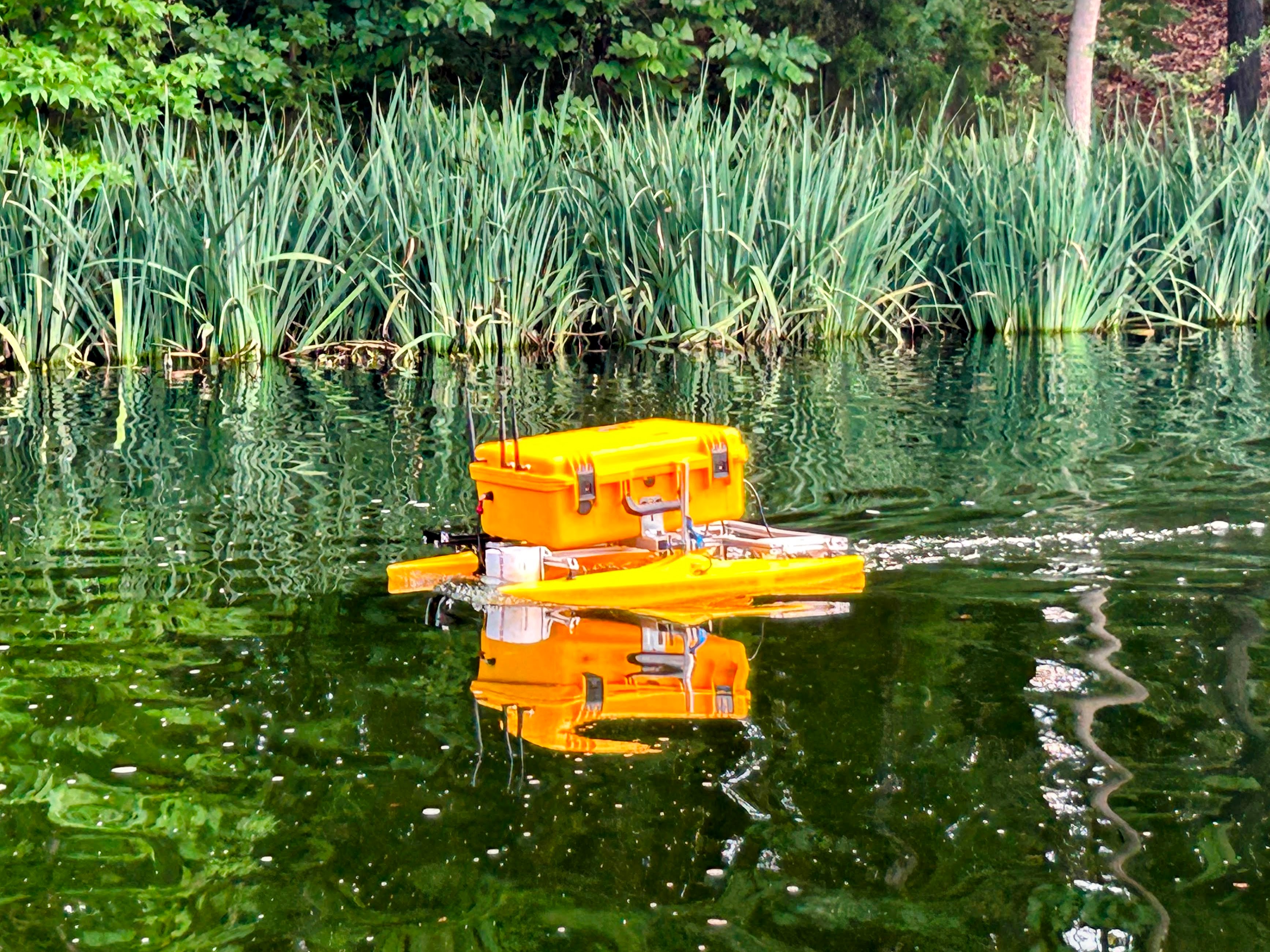
Mutual information~(MI) is a principled and widely used objective for robotic information gathering~(RIG), providing strong theoretical guarantees for sensor placement~(SP) and informative path planning~(IPP). However, its high computational cost—dominated by repeated log-determinant evaluations—has limited its use in real-time planning. This letter presents \emph{Schur-MI}, a Gaussian process~(GP) MI formulation that (i) leverages the iterative structure of RIG to \emph{precompute} and reuse expensive intermediate quantities across planning steps, and (ii) uses a \emph{Schur-complement} factorization to avoid large determinant computations. Together, these methods reduce the per-evaluation cost of MI from $\mathcal{O}(|\mathcal{V}|^3)$ to $\mathcal{O}(|\mathcal{A}|^3)$, where $\mathcal{V}$ and $\mathcal{A}$ denote the candidate and selected sensing locations, respectively. Experiments on real-world bathymetry datasets show that Schur-MI achieves up to a $12.7\times$ speedup over the standard MI formulation. Field trials with an autonomous surface vehicle~(ASV) performing adaptive IPP further demonstrate the method’s practicality. By making MI computation tractable for online planning, Schur-MI helps bridge the gap between information-theoretic objectives and real-time robotic exploration.